


Why do I feel different from other people? We Are Born to Belong So Relationships Shape Our Mental Health and Identity
- Kathryn Spence

- May 9
- 16 min read
Updated: May 10
By Kathryn Spence
InnerFocus Therapy
Accredited BACP Psychotherapeutic Counsellor, Accredited BABCP CBT Therapist, EMDR Therapist
May 2026

Why Do I Feel Different From Other People?
Many people come to this question in a very personal way:
Why do I feel different from other people?
Why do I struggle to fit in?
Why do I feel like I don’t belong anywhere?
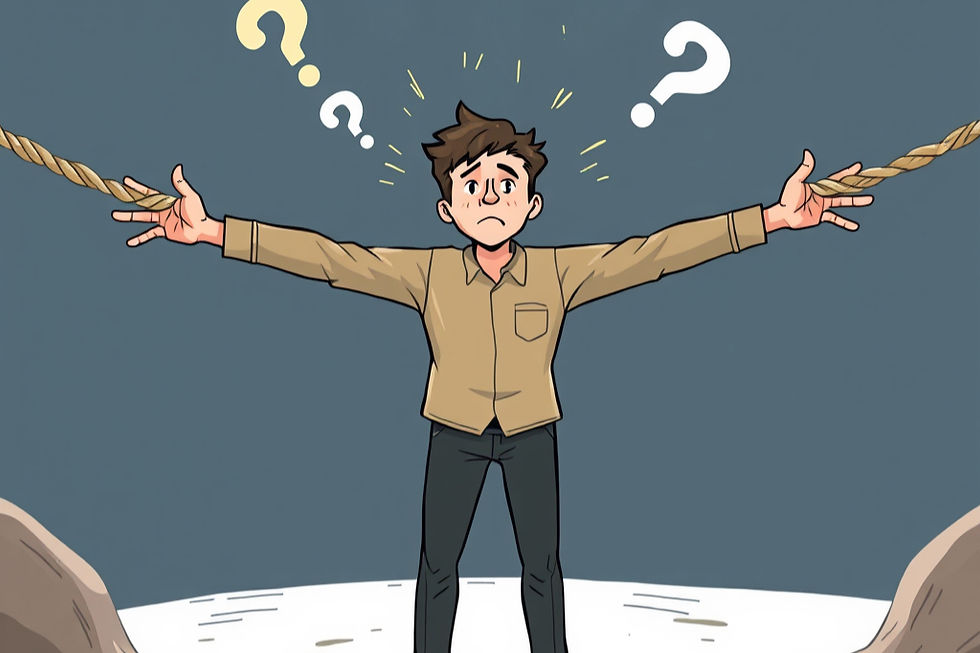
These experiences can feel isolating, as if something is wrong internally, but in reality they are deeply human. From the moment we are born, we are shaped through relationship. Our sense of identity, safety and emotional wellbeing develops not in isolation, but in connection with others. This means that feelings of disconnection or “not fitting in” are often not signs of defect, but signals of something relational — something in our early experiences, our environments, or the way we have learned to adapt in order to stay connected to others.
Yet, for a long time, mental health was spoken about as if it lived entirely inside the individual — a chemical imbalance, a faulty way of thinking, a lack of resilience.
But human beings do not begin life as individuals. We begin life in relationships.
Even before birth, babies are already responding to rhythm, stress, sound and emotional tone. In the womb, the earliest foundations of attachment are already beginning to form. And when we are born, we do not immediately experience ourselves as separate. In the language of Object Relations Theory, the infant does not yet know that mother is a separate person. At first, self and other belong to one world.

Only later — during what developmental theorists call Rapprochement — does the child slowly discover something enormous:
I am me, and you are not me.
That discovery is the beginning of psychological life as we know it.
And from that moment, another need becomes central: the need to belong.

Case Study: 'Daniel'
Daniel grew up in a home where emotional connection felt inconsistent. At times his mother was warm and engaged, but at other times she was withdrawn, critical, or emotionally unavailable. His father was physically present but emotionally distant and hard to reach.
As a child, Daniel became highly sensitive to emotional shifts in the household. He learned to monitor mood carefully and adjust himself accordingly in order to maintain connection. When tension was present, he became quiet and careful. When warmth returned, he moved closer and relaxed.
Over time, he developed a subtle but powerful belief: love had to be earned and could not be relied upon.
How the Need to Belong Shapes Who We Become
At first we need to belong to our caregivers. Then to our wider family system. Then school. Then peer groups. Then the wider social world. At every stage of life, we are learning the same quiet but powerful question:
Who do I have to be in order to stay connected?
When those early relationships are warm, stable and attuned, something vital grows inside us. If we are loved for who we are, delighted in, made to feel important and special, we usually develop an inner sense that relationships are broadly safe. We become more resilient. Criticism still hurts, but it does not define us.
But when relationships are shaming, frightening, neglectful, unpredictable, abusive — or simply emotionally unhealthy without any deliberate malice — something very different happens. The relationship we have with others then becomes the template for the relationship we have with ourselves.
A child who is criticised may become an adult who attacks themselves before anyone else can.
A child who is ignored may become an adult who assumes they are invisible.
A child who learns that closeness is dangerous may spend adult life longing for intimacy while fearing it at the same time.
Freud described part of this as Repetition Compulsion. We are often drawn back toward familiar emotional worlds — not because we enjoy suffering, but because partly our brains feel safer in familiar situations – we can predict what will happen next – and partly we are still trying to master what once overwhelmed us. We keep choosing versions of the old story, hoping this time it will end differently.
This is one of the roots of why people later feel different — they are not expressing a fixed identity, but an identity formed through adaptation to connection.
Why Belonging Is a Biological Need, Not a Social Nicety

Belonging is not simply something that feels nice. It is one of the deepest survival systems we have.
For most of human history, survival depended on group membership. Early humans lived in small cooperative bands. Food was shared. Protection was shared. Childcare was shared. Human infants are unusually helpless for unusually long periods. Without relationships, they simply would not survive.
Before exclusive pair bonding became the norm, humans almost certainly lived in communal groups where children were raised not only by parents, but by grandparents, siblings, aunts and others — what anthropologists call Alloparenting. Human babies needed whole groups.
Over time, pair bonding likely evolved because it improved survival. A more stable partnership could help protect children, provide resources and increase the chances that offspring would live long enough to thrive. Emotional attachment — what we now call love — was not merely sentimental. It was adaptive.
But pair bonds in our evolutionary past were not necessarily designed to carry what we ask of relationships today.
Children in ancestral environments became more independent much earlier. Many pair bonds may only have needed to remain stable for the first years of a child’s life. Today, children often remain emotionally, practically and economically dependent for twenty years or more. At the same time, adults live far longer than ever before.
That means modern couples are often asking one relationship to do something evolution never fully prepared us for.
We expect one person to be our co-parent, best friend, sexual partner, emotional confidant, financial teammate and lifelong companion — often for fifty or sixty years! In many ways, our brains evolved for short-term cooperative child-rearing systems, not lifelong nuclear-family emotional overload. We are asking ancient attachment systems to carry modern expectations they were never fully designed for.
It is no wonder relationships sometimes struggle. Not because modern people are failing. But because our social world has changed much faster than our emotional wiring.
Even our evolutionary cousins remind us of the importance of connection. Some researchers suggest that one of the great advantages Homosapiens had over Neanderthals was not superior intelligence, but larger and more flexible social networks. Bigger relational systems meant greater adaptability under pressure.
The social group was not a bonus.
It was life itself.
And psychologically, that is still true.

When people are chronically isolated, ostracised, abandoned or cut off from meaningful human contact, something begins to break down. Solitary confinement is psychologically devastating for a reason. Human beings are not built to regulate alone. It’s torture and severely affects our physical and emotional wellbeing — people often become more anxious, depressed, dysregulated, hypervigilant, hopeless and cognitively impaired, even psychotic, while the body itself can begin to show the strain through disrupted sleep, increased stress hormones, lowered immunity and a greater risk of illness. Loneliness is felt as physical pain and causes Cortisol, our stress hormone, to be released – this is a protective measure against isolation.
We also define ourselves through comparison — and often that comparison tilts toward the negative. Evolutionarily, this made sense: being excluded from the group was genuinely dangerous. Without collective protection and shared resources, survival was far harder alone. The same logic applied to accumulation. Better tools, more food, stronger shelter, more children — for most of human history, more was not greed, it was wisdom. It is little wonder that the modern mind still reaches instinctively for more, even when the original threats that shaped that drive no longer exist in the same form. This all maintains our cognitive habit to compare ourselves to others, which divides we as well as helps reinforce our sense of identity and belonging within groups.
How We Learn to Belong — and What Happens When It’s Complicated
As children grow, belonging becomes more complicated.

Case Study continued: 'Daniel'
At school, Daniel was socially capable but internally anxious. He learned to present a version of himself that was easy to like — humorous, competent, agreeable — while keeping more vulnerable feelings hidden.
He was often accepted socially, but rarely felt fully known.
Belonging began to depend on adaptation: fitting in, staying liked, and avoiding anything that might risk rejection or embarrassment.
At first, the task is attachment.
Later, it becomes adaptation.
And then adolescence arrives.
Adolescence marks a major shift in the human need to belong. The centre of gravity moves away from parents and into the peer group. Friendships become more important, but also more complex, as young people begin to navigate acceptance, exclusion, status, and identity all at once. In this stage of development, belonging is no longer just about being cared for — it becomes about being chosen.

Young people begin to ask, often unconsciously, what they need to be in order to stay included. Peer groups form their own micro-cultures, where similarity is rewarded and difference can quickly become risky. The pressure to fit in is not simply social — it is deeply psychological, shaping identity itself during a time when the brain is still developing systems for impulse control, emotional regulation, and long-term perspective.
It is also a period where belonging becomes increasingly visual and comparative. Alongside behaviour and personality, appearance begins to carry significant weight in determining perceived social value. These are ancient evolutionary systems — once used to quickly read safety, status, and belonging within small groups — now exposed to a very different environment. Through digital media, we are confronted with an endless stream of carefully curated bodies, lives, and identities, creating a background pressure of comparison that our nervous systems were never designed to process at this scale. We were built to live within relatively small groups, not be 'connected' to billions of people! Belonging becomes entangled with appearance in a far more intense way, leading many people to feel that in order to be accepted, they must not only behave differently, but also look different.
This marks a subtle but important shift: belonging is no longer only about connection to others, but about continual self-adjustment in relation to an idealised social image that is always just out of reach.
Adolescence is also one of the most emotionally demanding periods of development — a time when young people begin separating from parents in order to become individuals. That often involves pushing away from family, challenging authority, and turning more intensely toward peers. We are actually doing a good job as parents if, during this time, our child feels safe enough to say in their hormonally-charged state "I hate you" (insert Kevin the Teenager from Harry Enfield and Chums!). They feel safe enough to express their need to separate — and they are, in fact, separating!
This is also why peer rejection can feel so devastating. Adolescents are trying to answer one of the oldest human questions — where do I belong? — while their brains are still developing, hormones are intensifying emotional experience, and identity itself still feels fragile.
In this way, feeling "different" is often not a sign of separation from others, but a sign of how closely someone has learned to monitor and adjust themselves in order to belong.
Peer pressure is not trivial. It is a relational survival issue. And this is often where we begin to adapt more consciously.
If being spontaneous gets mocked, we become careful.
If being sensitive gets ridiculed, we toughen up.
If anger threatens connection, we become pleasing.
If being different risks exclusion, we start hiding parts of ourselves.
This is what I wrote about in my blog on psychological impasses.

Sometimes we do not merely suppress aspects of ourselves. We bracket them off for survival. Parts of us become too dangerous to belong.
A person may learn that their neediness is unacceptable, so they 'stop needing'.
Another may learn that anger risks rejection, so anger becomes suppressed.
Another may learn that vulnerability invites shame, so vulnerability disappears behind competence.
This is not weakness. It is adaptation. However, the bracketed-off parts can later appear as dissociation, inner conflict, emotional numbness or fragmented identity, causing later emotional and physical health problems.

And the emotional mechanism that often enforces this adaptation is shame. Shame is deeply relational. It does not simply say, I did something bad. It says, there is something bad about me. That is where what I wrote about in the moral defence blog becomes so important:
Children will often blame themselves rather than risk feeling that the people they depend on are unsafe. It can feel psychologically safer to believe I am bad than to believe my caregivers are frightening, rejecting or unreliable. Because if I am the problem, perhaps I can fix myself. And perhaps then, I can still belong.
Under times of trauma, often relational trauma, it is ironically relationships which help us heal and move on. This is also why Carolyn Spring’s bears fable is so powerful:
Trauma and the bears – a fable:
The point of the story is not simply that frightening things happen. The point is that trauma is shaped not only by what happens to us, but by what happens next.
In the fable, a person encounters a bear and runs back to the tribe terrified. But then something crucial happens. They are met. They are listened to. Their fear makes sense to others. The tribe helps them understand what happened, tends to the wounds and restores safety.
The frightening event becomes something that can be emotionally processed because it is held in relationship.
But when there is no tribe — no witness, no comfort, no meaning-making, no one helping the nervous system return to safety — the body often remains organised around danger.

That is the deeper truth of trauma.
We do not recover simply because the danger has passed.
We recover because someone helps us know we are safe again.
That is why relational trauma cuts so deeply.
The very thing that should help us heal — relationship — is often the thing that caused the wound.
When the Need to Belong Becomes Destructive: Identity, Fear, and “Us vs Them”
There is a paradox here. We can only truly belong through difference.
Healthy belonging does not require us to become identical to one another. It requires enough safety that difference can exist without threatening connection.
But human beings often struggle with difference.
Throughout human history, persecuted groups have escaped to remote areas to live in peace, finally free to build a life together without outside threat. At first, there is unity and shared purpose, but over time differences begin to emerge around beliefs, rules and how the community should be organised. The group gradually fractures into smaller sub-groups, which eventually separate and even come into conflict with one another. The key point is that their original sense of belonging had been strengthened by an external “other” that defined their identity. Once that outside boundary disappeared, so did the glue that held them together, and new internal divisions formed in order to recreate a sense of identity, belonging and meaning through “us and them” distinctions.
The same need to belong that creates love, loyalty, family and community can also create exclusion, prejudice, religious conflict, nationalism and war.
When people feel frightened, insecure or cut off from belonging, groups often become more rigid, more defensive and more hostile to difference. Difference begins to feel dangerous. Identity hardens. People cling more fiercely to “us” and become more suspicious of “them.”
This is not only a political truth. It is a psychological one. Belonging can unite us.
But when it becomes organised around fear, it can divide us too.
Neurodivergence, Minority Experience, and the Hidden Cost of Fitting In
For some people, belonging is not simply emotionally difficult — it is structurally harder.
Many neurodivergent people want connection deeply, but may struggle with the unwritten rules that govern social life. Timing, tone, eye contact, pacing, hidden expectations, group dynamics — these things can feel natural to some people and deeply effortful to others.

Often the problem is not lack of social desire.
It is a painful mismatch between the person and the social environment.
The same can be true for people who live as part of any minority.
When you repeatedly feel different from the dominant social world — culturally, neurologically, racially, sexually, religiously or otherwise — belonging can start to require constant adaptation.
Masking — hiding parts of yourself or copying social behaviour so you seem more acceptable or less different.
Softening — toning down your feelings, opinions or personality so you do not seem too intense, difficult or threatening.
Explaining — feeling you have to justify yourself, your reactions or your differences so other people understand or accept you.
Editing — carefully filtering what you say, feel or show so only the parts most likely to be accepted are visible.
Code-switching — changing the way you speak, behave, present yourself or express parts of your identity depending on who you’re with, in order to fit in, be understood or stay safe.
And over time, that can quietly affect the relationship you have with yourself. Not fitting in can slowly become not feeling good enough.
Mental Health Problems as Relational Adaptations: A New Way of Understanding Symptoms
This is why I believe something very simple and very important:
All mental health problems are effectively relational.
Not because every symptom is caused only by relationships. But because almost every form of psychological suffering contains a relational story.
Complex PTSD often emerges when the source of danger was also the source of attachment.
Dissociation often develops when experience was too overwhelming to hold and there was no safe relational space to process it.
Social anxiety often carries fear of humiliation, exclusion or judgement.
Low self-esteem often reflects internalised relational experience.
Fear of intimacy, fear of abandonment, fear of engulfment, chronic shame, fear of criticism — all of these are deeply relational states.
Even what we call personality disorders can often be understood as relational adaptations:
As Elinor Greenberg writes, the person with a schizoid adaptation often desires connection deeply but fears it too. Closeness may feel engulfing, invasive or dangerous, so distance becomes safety. However, then someone with a schizoid style may leave others feeling shut out, rejected or quietly confused, compounding the relational wound.

The person with a narcissistic adaptation often carries unstable self-esteem shaped by shame. Admiration becomes a way of holding together a fragile inner world. Then, someone organised narcissistically may create a hierarchy in which others feel criticised, diminished or never quite enough, destroying any ability to connect, as it feels too unsafe to be vulnerable.
The person with a borderline adaptation often longs intensely for love while also fearing abandonment and engulfment at the same time. And someone organised around borderline dynamics may leave others feeling overwhelmed, emotionally responsible or unable to get it right, causing further relationship fractures.
These are not simply labels or diagnoses. They are attempts to survive emotionally in a relational world. Understanding the interpersonal impact often helps us understand the wound.

Case Study continued: 'Daniel'
In adult relationships, Daniel repeatedly finds himself drawn to emotionally intense but inconsistent partners. Early closeness feels exciting and stabilising, but over time he becomes increasingly anxious and preoccupied with signs of distance or rejection.
When intimacy increases, he often feels overwhelmed and begins to withdraw. When distance grows, he feels abandoned and tries to re-engage.
He describes the experience as being caught in a cycle of “wanting closeness but not being able to stay settled in it.”
Over time in therapy, this pattern begins to make sense not as personal failure, but as an adaptation shaped by early relational experience — a way of trying to stay connected in relationships that once felt unpredictable.
Daniel’s experience shows how the feeling of being different is often not about who we are, but about how we learned to stay connected in relationships that did not always feel safe or consistent.
How Psychotherapy Understands Relational Patterns — Attachment, CAT, and Transactional Analysis
Whatever brought you to this point — a pattern you keep repeating, a relationship that feels familiar in all the wrong ways, a way of being that no longer serves you — therapy offers a way of making sense of it.
Different approaches use different language, but they are often illuminating the same thing: that the way we learned to connect with others in early life becomes a kind of internal template. We begin to expect what we once experienced. We reach for what feels familiar. We protect ourselves from the pain we once couldn't avoid.
You may recognise some of this in yourself. Perhaps you find yourself chasing people who are hard to reach, or pulling away just as someone gets close. Perhaps you criticise yourself before anyone else can, or resist help even when you desperately need it. Perhaps you feel invisible, or trapped, or under constant pressure to be more than you are. These are not random quirks. They are often the echoes of early relational experiences — patterns that once made sense, that helped you stay connected or stay safe, but that now quietly shape your relationships, your self-worth, and your inner life.
In therapy, and through the relationship with a therapist, those patterns can finally be seen for what they are — and for the first time, something different becomes possible.

Healing from Relational Trauma: Why Connection Is Also the Cure
In this sense, feeling different is not a personal flaw, but a relational adaptation — a way the self learns to survive in connection. And this is where the hopeful part begins. If so much suffering is relational, then healing can be relational too. Not only through therapy — though therapy can be profoundly important — but through friendships, communities, healthier love and the relationship we build with ourselves.
Healing often begins when we no longer have to abandon ourselves in order to stay connected.
When we are met rather than judged.
When our pain makes sense to someone.
When we no longer have to perform, hide or become smaller.
Slowly, something changes. The nervous system learns. The self learns.
The person who once expected rejection may begin risking honesty.
The person who once hid may begin allowing themselves to be seen.
The person who believed they were too much, too needy, too different, too damaged, may begin to discover something else.
Not perfection. But possibility.
The possibility that what once made sense may no longer be necessary.
The possibility that they were never the problem in the way they imagined.
The possibility that belonging does not require self-abandonment.
And that may be one of the deepest truths in mental health. We are wounded in relationship. But we also heal there. If all mental health is relational, then all mental health contains relational hope. Because no matter what happened in the past, the story is not finished.
A new relationship — with another person, with a therapist, with a community or with yourself — can still change what comes next.
Lastly, please know that it’s absolutely OK to be different, we’re all different and in the right relationships that difference is accepted and enjoyed - find your people!! 💕

What's Next For You?
If this blog resonated with you and you’re curious about how relationships have shaped your mental health and identity, consider taking the next step. Whether it’s exploring therapy, joining a supportive community, or simply reflecting on your relational patterns, remember that healing and growth are possible. At InnerFocus Therapy, we specialize in helping individuals navigate these challenges and rediscover their sense of belonging. Reach out today to start your journey toward deeper connection and well-being.
Please follow me on Social Media for more information:
Facebook: @innerfocustherapynewcastle
Instagram: innerfocustherapy
I am an accredited therapist and offer in-person therapy in Newcastle upon Tyne (UK) as well as online therapy within the UK. Please contact me to enquire about therapy:
References
Ainsworth, M. D. S., Blehar, M. C., Waters, E., & Wall, S. (1978). Patterns of Attachment. Psychology Press.
Bartholomew, K., & Horowitz, L. M. (1991). Attachment styles among young adults. Journal of Personality and Social Psychology, 61(2), 226–244.
Berndt, T. J. (2004). Friendship and social development in children and adolescents. New Directions for Child and Adolescent Development, 2004(104), 69–78.
Bowlby, J. (1969/1982). Attachment and Loss: Vol. 1. Attachment. Basic Books.
Bronfenbrenner, U. (1979). The Ecology of Human Development. Harvard University Press.
De Goede, I. H. A., Branje, S. J. T., & Meeus, W. H. J. (2009). Developmental changes in adolescents’ friendships. Journal of Adolescence, 32(5), 1051–1065.
Elinor Greenberg, Ph.D. (2019). Divided self-structures and personality adaptations. Psychology Today. https://www.psychologytoday.com/gb/blog/out-the-darkness/201912/divided-we-fall
Freud, S. (1920). Beyond the Pleasure Principle. Hogarth Press.
Fonagy, P., Gergely, G., Jurist, E., & Target, M. (2002). Affect Regulation, Mentalization and the Development of the Self. Other Press.
Holmes, J. (2014). John Bowlby and Attachment Theory. Routledge.
Laing, R. D. (1960). The Divided Self. Penguin Books.
Spring, C. (n.d.). Trauma and the bears (fable). https://www.carolynspring.com/blog/trauma-and-the-bears/
Steinberg, L. (2014). Age of Opportunity: Lessons from the New Science of Adolescence. Houghton Mifflin Harcourt.
Twenge, J. M. (2017). iGen. Atria Books.
Children’s Mental Health Week (2026). Families and Communities Pack. https://www.childrensmentalhealthweek.org.uk/media/yrnb3g2g/families-and-communities-pack-childrens-mental-health-week-2026.pdf


Comments