
Why Do I Feel So Stuck? A Guide to Psychological “Impasses”

By Kathryn Spence
InnerFocus Therapy
Accredited BACP Psychotherapeutic Counsellor, Accredited BABCP CBT Therapist, EMDR Therapist
April 2026
This blog is for anyone interested in understanding their own stuckness, but it is also hopefully a simplified explanation of Impasse Theory, Discount Matrix and the Structural Order Ego State Model (Transactional Analysis) for therapists and trainees.
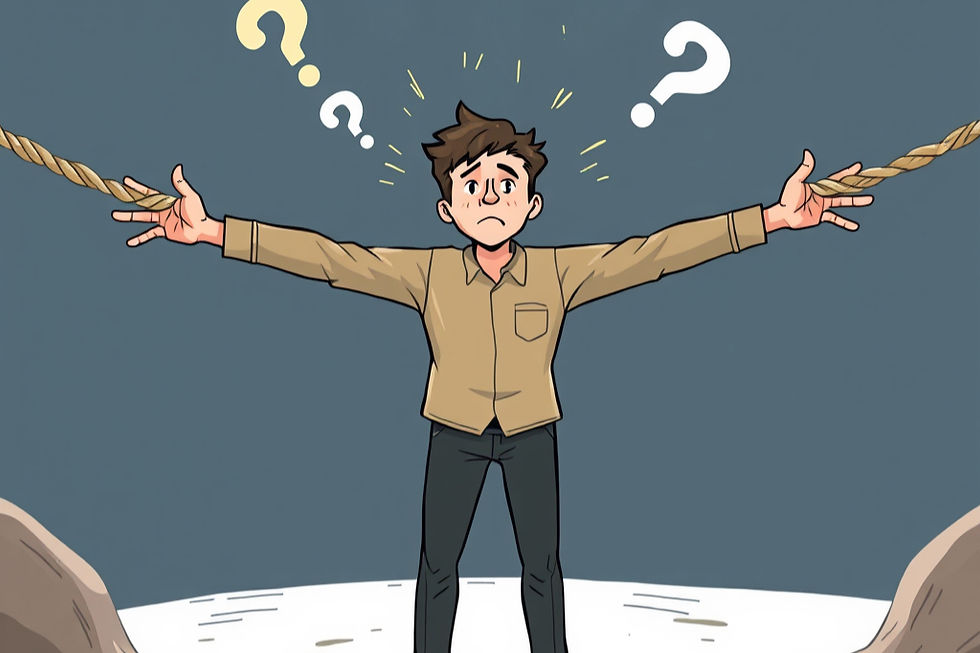
Have you ever felt like part of you wants one thing… and another part shuts it down?
You want to speak up – but you go quiet
You want closeness – but pull away
You want to relax – but your body won’t let you
This isn’t just indecision or a lack of willpower. It’s something deeper. In psychology, this is called an Impasse.
What is an Impasse?
An impasse is an inner standstill – where two parts of you pull in opposite directions, and both feel necessary, even at a survival level.
It often begins in moments where it didn’t feel safe or acceptable to be your true self. To maintain connection, you had to push away part of your experience.
One part of you was kept. Another was disowned.
For example:
As a child, you come home upset after making an embarrassing mistake at school. You cry and seek comfort, but your caregiver responds, “You’re always getting upset – you need a thicker skin.”
You don’t actually develop a thicker skin. Instead, you learn to hide your sadness.
But those feelings don’t disappear – they get pushed aside and show up in other ways. Perhaps as perfectionism, driven by an early rule like:
“I must be perfect so I don’t make mistakes, feel ashamed, or need support.”
Later in life, the impasse might sound like:
“If I do this, I’ll fail and be judged… but if I don’t do it, I’m a failure.”
So, you get stuck.
Not because you’re weak, lazy, or stupid – but because part of you is trying to protect you.
And that stuckness can be incredibly hard to shift, because deep down, it still feels like survival is at stake.
An important point – An impasse isn’t just a moment of feeling a bit stuck or unsure, it’s something far more persistent. It tends to be chronic, familiar, and deeply ingrained, showing up in the same patterns again and again, often across different areas of life. You might notice it in your relationships, your work, or your sense of self – the same push and pull, the same stuckness, no matter how much insight or effort you bring. And it has real consequences: missed opportunities, strained connections, ongoing anxiety or frustration. What makes it so powerful is that it doesn’t feel like a choice, it feels like the only way your system knows how to keep you safe.
Where do Impasses Come From?
Impasses often begin in early childhood. As a child, you are completely dependent on your caregivers for safety, comfort, and survival. But when those same people are also a source of stress, rejection, or confusion, you face an impossible situation:
“I need this person to survive.”
“This person hurts me or doesn’t meet my needs.”
You can’t leave. You can’t reject them. You can’t fully make sense of it.
This is the moral defence.

The Moral Defence - neglect 
The Moral Defence - description 
The Moral Defence - aggression
So your mind does something very clever – it splits the experience. You hold onto the parts that help you stay connected, and push away the parts that threaten that connection. Over time, that split becomes an impasse.
For example, if you cry and are told, “boys don’t cry,” “wipe those tears away,” or “you’re too sensitive,” the message becomes: don’t feel sad.
You might disconnect from sadness altogether, replace it with another emotion (sometimes called a racket feeling; for example, feeling anger instead of sadness), or learn to hide it behind a “brave face.” The impasse then becomes: the need to feel sadness but not being able to express it, or even access it.
It’s important to be clear that these patterns don’t usually come from a single incident, or even just a few isolated moments, unless there has been a significant trauma. More often, they develop over time through repeated experiences of misattunement or small attachment injuries that gradually shape how we relate to ourselves and others.
This isn’t about blaming parents or caregivers. In many cases, parenting may have been “good enough” overall, with love and care present, but with certain emotional needs not fully met. Often, those gaps weren’t intentional – they can reflect what was missing in previous generations too. Most parents are doing their best with what they know and have experienced themselves.
Understanding this is not about assigning fault, but about making sense of how these patterns formed. By recognising where an impasse may have originated, we create the possibility of working with it and loosening its hold in the present. That said, it’s also important to acknowledge that in some cases, these patterns can stem from more overtly harmful or abusive experiences.
What is an attachment injury explained Examples of attachment injuries critical parent, child upset and self blaming
The Three Layers of Being “Stuck”
Not all impasses are the same. They form at different stages of development and show up differently in adult life.
Third Degree Impasse at The Body Level: “Am I safe to exist?”
This is the earliest layer, formed in infancy; usually between conception and around one year old. At this stage, you are pre-verbal, you don’t have thoughts or even clear emotions yet. You just have raw bodily experience. In addition, you don’t yet know you are separate from your caregivers, so everything you experience is felt as ‘all of me’. You can only discriminate between pain and pleasure at a somatic level.
If something goes wrong here, such as a lack of soothing when distressed, neglect, or overwhelm, the impact is deep.
Instead of a cognitive belief like “Something is wrong”, it is felt at a somatic level as raw pain and feels more like tension, badness, wrongness, unsafety or non-existence. It is about our very being and energy – it feels real and is not cognitive – it’s urges and body sensation.
In later life, this may show up as:
Chronic tension or shutdown
Anxiety without a clear cause
Difficulty relaxing
Tension
‘Deadness’
‘Emptiness’
Feeling “on edge” or “numb”
It also is related to basic life processes such as circulation, digestion and respiration, so it can show up as issues with breathing, digestion, chronic tension, or a deep sense that it is not ‘safe to exist’.
You CANNOT think your way out of. It lives in the body.
Second Degree Impasse at the Emotional Level: “Can I feel and be loved?”
As you grow, you begin to feel emotions, express your needs by more than just crying, and are able to reach out to others. This is generally between the ages of 4 months and 4 years. You may have been shamed for having certain feelings, been ignored when you were in need of support, or punished or criticised for certain feelings or needs.
And now the conflict becomes more emotional:
“If I show how I feel, I might lose love.”
So, you adapt, you base decisions on how you feel. Maybe you learn:
Not to cry
Not to get angry
Not to need too much.
It links to our Child Injunctions [see TA Blog] so are more around how not to be: Don’t be you, Don’t be important, Don’t be close, Don’t feel, Don’t think, Don’t belong, Don’t be well, Don’t succeed, Don’t grow up, Don’t be a child.

Injuctions described 
Injuctions described 
Injuctions described
Later in life, you are unlikely to be aware of the origins of these decisions, but it shows up later in various behaviours, such as:
Difficulty expressing emotions
People-pleasing
Fear and avoidance of conflict
Feeling disconnected from your own feelings
Pain or health complaints such as tight chest, held breath, rigid posture, locked jaw, frozen belly, fewer facial expressions (not showing too much), restricted voice (not taking up too much space), soft childlike voice with less intensity (more hesitant or passive).
Here, the impasse is between being yourself and staying connected to others. And again, using words doesn’t help much to shift this stuckness.
First Degree Impasse at the Thinking/Social Level: “Who do I have to be to belong?”
At a later developmental stage, 2 years plus, you develop language, identity and an awareness of social rules. Now the conflict becomes about who you think you are.
“To be OK and accepted, I need to be…”
These decisions are more cognitive and made with words. They are also the most familiar to us because they show up as thoughts and beliefs; our internal monologue.
The distress and pain in misconnection or harm being caused to you by others, is connected with your social world, which now has expanded to include a wider network of people, rather than being focused solely on your caregivers. This includes your family’s expectations, social and cultural rules, the roles you have been ‘assigned’ which start to form your identity (e.g. the eldest helpful child, the responsible one, the baby, the golden child, the strong one, the sensitive one), it includes how others perceive and judge you and how you are compared to others.
It links to our Parent Counter-Injunctions or ‘Drivers’ [see TA Blog]:

Be Perfect
Please Others
Be Strong
Try Hard (but don’t succeed)
Hurry Up
It may show up in later years as:
Harsh self-criticism
Overthinking
Pressure to perform
Fear of judgment
Fear of being seen as vulnerable or ‘weak’
Negative comparisons to others.
Here, the impasse is between being yourself and finding a sense of belonging. However, using words and reframing believes can help to shift this stuckness.
Caveat: It is possible to have all three levels of impasse, as well as have an overlap between the impasses which are not quite as age dependent. For example, a severe trauma at a later age, can cause an impasse at both level 2 and 3.
Why You Can’t Just “Fix It”
When an impasse is activated, people re-experience the conflicts in their ‘guts’, it’s a felt sense, rather than in their heads.
And each level of impasse has to be resolved at its own level. That means:
You can’t solve a body-level issue with thinking
You can’t solve an emotional block with logic alone
You can’t talk your way out of something your nervous system is holding.
This is why advice like “just think differently”, “stop it” or “just do it” often doesn’t work. It’s the wrong tool for the level of the problem.
What Your System Was Trying to Do
Your impasse is not a flaw. It’s a solution your system came up with under pressure, which actually worked! It was a genius solution that your young self came up with before your brain had a chance to fully develop, you had a chance to learn more from the world we live in, or become a more autonomous person who was not as dependent on the care of others to survive.
As a child, it helped you stay connected, stay safe and survive emotionally. The problem is… you’re still running that solution now, even when it’s no longer needed.
How the Impasse Problem gets Hidden
Impasses lead to the need to discount reality to make them fit, and this in turn maintains the impasse. When we are Discounting, we are ignoring or minimising something that would require change.
It has 4 levels:
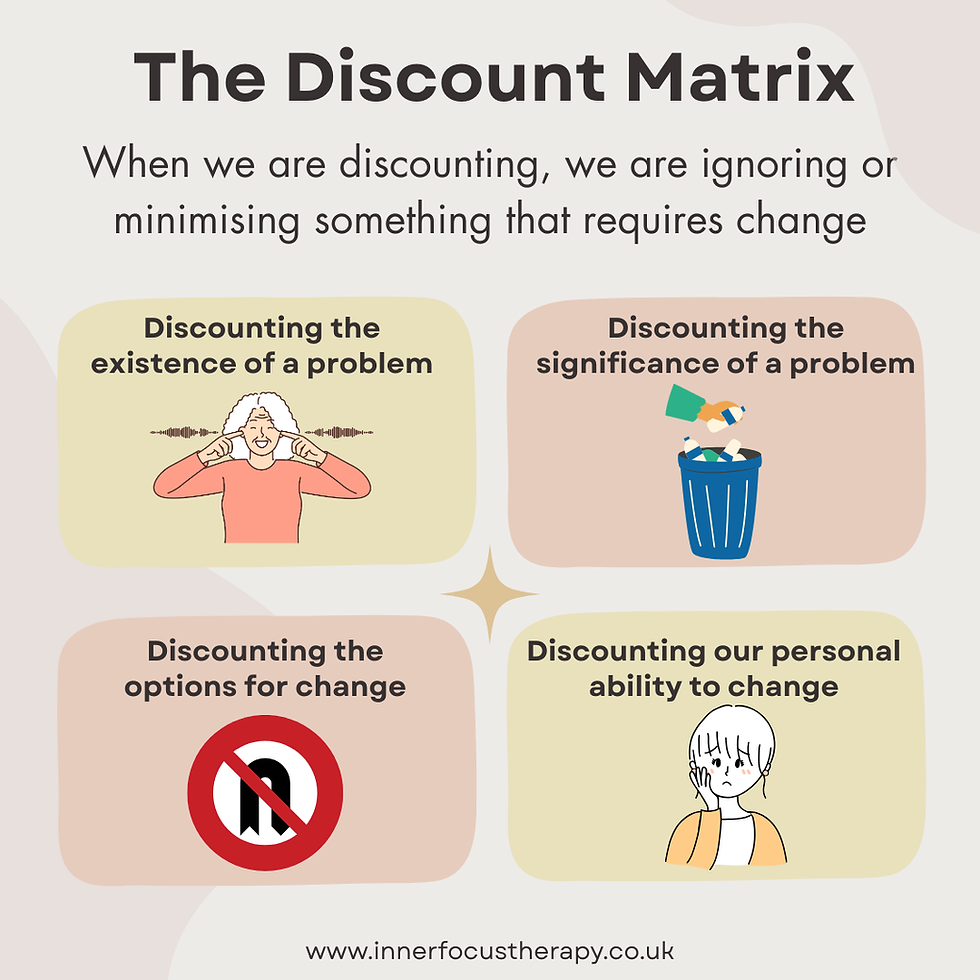
Discounting the existence of a problem
Discounting the significance of a problem
Discounting the change options
Discounting our personal ability to change
Third degree impasses, at the body level, are often also discounted at the level of existence of the problem, because it is preverbal and not necessarily in our awareness. A person may be discounting internal states entirely. For example,
“I don’t feel anything” (when they do)
“Nothing is wrong” (when body is dysregulated)
Lack of awareness of needs
The person is not just minimising – they are not registering parts of reality.
Second degree impasses, at the emotional level, are often discounting the significance of a problem. For example, the emotional conflict if felt, “If I feel i.e. sad, then I lose connection”, so feelings are acknowledged but minimised. Examples:
“I’m not really angry”
“It doesn’t matter”
“It’s not a big deal”
The feeling exists, but is made unimportant.
First degree impasses, at the cognitive level, discounts options and/or ability to solve a problem. For example, reality is recognised, but change is ruled out:
“There’s nothing I can do”
“That wouldn’t work”
“I couldn’t handle it”
Options exist, but are dismissed.
The problem is that these levels reinforce the impasse:
At the Being level → “I’m fundamentally wrong”, the problem isn’t identified so never changed so the felt sense cannot change.
At the Emotional level → “My feelings don’t matter / are dangerous”, so those feelings are minimised so the impasse cannot be resolved.
At the Cognitive level → “I can’t act / shouldn’t act”, so no change occurs which maintains the behavioural adaptations and underlying anxiety.
This all results in inhibition, anxiety, avoidance or passivity. And the deeper the discount, the deeper the impasse.
What Resolution Actually Looks Like
Resolving an impasse isn’t about forcing change. It’s about:
1. Recognising the split

Seeing both sides of the conflict clearly:
“Part of me wants this… Another part is afraid of it…”
2. Understanding where it came from
Connecting it to:
Early experiences
Emotional learning
Patterns of adaptation
3. Working at the right level
We need to have a new embodied or relational experience which allows us to come through the impasse:
Third Degree Impasse – Body
If it’s bodily → it needs regulation and safety in the body.
Resolution requires somatic or pre-verbal access, this may include:
Access to body states, not just feelings
Work with nervous system regulation
Somatic awareness / mindfulness of bodily states
Tracking autonomic responses
Nonverbal expression (movement, sound, imagery)
Very early relational attunement in therapy
Bottom-up processing (body → brain)
Felt sense, not narrative
Regulation before insight
You experience safety where there used to be threat
Resolution would feel like a shift in a felt sense of safety / existence.
Therapy models which can help with this could include:
Somatic Experiencing (SE)
Sensorimotor Psychotherapy
Eye Movement Desensitization and Reprocessing (EMDR)
Attachment-based / developmental therapies
Somatic / mindfulness-based approaches
Second Degree Impasse – Emotional
If it’s emotional → it needs to be felt and expressed.
This may involve:
Re-experiencing early affect – accessing shame, fear, anger linked to caregiver interactions
Emotional expression and permission – allowing disowned feelings to be felt safely
Relational reworking – for example, a therapist provides a different response than the original parent
Accessing authentic childhood feelings
You may need to use the body, tone of voice, facial expressions to give the message or release what’s held.
Therapy models which can help with this could include:
Redecision Therapy (classic TA approach)
Gestalt Therapy
Emotion-Focused Therapy (EFT)
Psychodynamic / relational therapy
Internal Family Systems (IFS)
Cognitive Analytic Therapy (CAT)
First Degree Impasse – Cognitive
If it’s cognitive → it can be rethought and reframed.
You might need:
New insight
Talk about your feelings
Update your thinking
Reframe the earlier experiences
Give yourself other permissions
Therapy models which can help with this could include:
Cognitive Behavioural Therapy (CBT)
Rational Emotive Behaviour Therapy (REBT)
Solution-Focused Brief Therapy
Acceptance and Commitment Therapy (ACT)
Transactional Analysis (TA)
Cognitive Analytic Therapy (CAT)
At whichever level you are working, it is the presence of another person who provides space and acceptance of these feelings in order to reduce the shame connected to these states. After all, shame arises from how we experience ourselves in relation to others when that connection is disrupted or broken.
So, what is Resolution of an Impasse?
This is the most important part. Real change happens when you have new experiences where you have re-experienced both “poles” of the conflict (the authentic feeling and the adaptation) and made a “Redecision” at the same level the original decision was made.
What does this actually mean? Both sides have to come back into awareness at the same time. The shift happens when the system experiences both simultaneously, and realises the original constraint is no longer absolute.
For example, a woman begins to feel anger (something once disallowed) and at the same time, fear or guilt arises, and instead of shutting one down, both are allowed. The impasse starts to resolve when you can stay in contact with both poles without collapsing into one. And that creates a new possibility; anger and connection, expression and safety.
At the emotional level this may be like feeling anger and feeling fear/shame together.
At the body level this may be like bodily activation (e.g. anger energy) alongside bodily fear (tightness, freeze) where both need to be tolerated in the body.
Why this leads to “redecision”? Once both poles are fully experienced the original “decision” (e.g. “I must not be angry”) can update. Not because you tell it to, but because the system now has more information and the old rule is no longer the only way to survive.
A simple analogy to explain this: it’s like the system originally learned:
“This wire carries electricity → don’t touch it or you’ll die”
Re-experiencing both poles is like touching the wire (feeling the impulse) and discovering it’s no longer live.

How to Spot Your Own Impasse
Ask yourself:

What do I want to do, but can’t?
What feels risky or unsafe about doing it?
What part of me is trying to protect me?
That tension you feel? That’s your system holding two truths at once – and not yet knowing how to reconcile them.
Remember, at some point in your life, you had to choose between being yourself and staying connected or safe. And your system chose survival. Understanding that is the first step toward moving forward.
Summary Table
Degree of Impasse | 3rd – Body | 2nd – Emotion | 1st - Cognitive |
Conflict | Being – safety to exist | Expressing self – connecting to others | Thinking – need to belong |
Age of typical development | Conception to 4 months | 4 months to 4 years | 2 years onwards |
Awareness | No awareness of origins of conflict, timeless – not anchored in time (implicit memories held fully in Amygdala) | Little awareness of origins of conflict, not particularly anchored in time (implicit memories held mainly in Amygdala) | Can have explicit memories about the origins of the conflict, time-stamped as past/present/future (explicit memories held in Hippocampus) |
Attachment | No separation from caregivers “all is me” | Some separation from caregivers | Between some separation from caregivers to more autonomy |
Communication | Energy carries messages, | Feelings carry messages | Words carry messages |
Verbal skills | Can only discriminate between pain and pleasure, non-verbal | Some words possible, feeling based decisions | Increasing with age; cognitive and emotional based decisions, feelings have labels |
Ego-State Model age and stage of development - see model below | Infant Ego States P0, A0, C0 “Body remembering State” A0 decision | Child Ego States P1, A1, C1 “Experiential State” A1 ‘Little Professor’ decision | Child Ego States P2, A2, C2 “Meaning making State” A2 decision |
How it is held in the self | Being states and energy | Injunctions | Counter-Injunctions / Drivers |
How it presents | Felt sense of unsafety, badness, wrongness, not OK to exist | Disconnected from own emotions | Avoidance, rehearsing, procrastination, perfectionism, people pleasing |
Manifestation | Tension, deadness, chronic unease, breathing issues, digestion problems | Tight chest, held breath, rigid posture, locked jaw, frozen belly, fewer facial expressions, restricted voice | Rejection sensitivity, anxiety, tension, restlessness, shame, harsh self-criticism, overthinking, fear of judgment, negative comparisons to others |
Parenting (or wider community influence) | Trauma, abuse, neglect, lack of soothing when distressed, physical discomfort without comfort being offered | Shamed for emotions, ignored when needing comfort, punished for feeling of having needs | Criticism, high standards, unreasonable expectations, parentification, bullying, difficult peer relationships, social or cultural pressures |
Discounting | Discounted at the level of existence of the problem | Discounted at the level of significance of the problem | Discounted at the level of options for change and/or ability to change |
Redecision | Needs regulation and safety in the body | It needs to be felt and expressed | It can be rethought and reframed |
Resolution | A shift in a felt sense of safety / existence | Access to all emotions and able to express them healthily | Able to think and act in accordance with the here and now situation |
Mapping to Structural Order Model
The Second Order Structural Model is a model used in Transactional Analysis to formulate the origins of a person’s presentation, help increase understanding about what is activated, as well as provide a map to aid resolution.
Impasse Theory links directly to this model, so I have provided an additional pictorial version for reference below in case you are interested in more information about this, or other therapist who are referring to this blog would like more detail.

Please follow me on Social Media for more information:
Facebook: @innerfocustherapynewcastle
Instagram: innerfocustherapy
I am an accredited therapist and offer in-person therapy in Newcastle upon Tyne (UK) as well as online therapy within the UK. Please contact me to enquire about therapy:
References
This article draws on Transactional Analysis theory, particularly Mellor’s model of impasses and Schiff’s work on discounting. The explanations presented here integrate these ideas with contemporary relational and somatic perspectives to make them more accessible.
Impasses and discount matrix are core TA concepts but not heavily researched in mainstream psychology, therefore this blog is a clinical framework within Transactional Analysis rather than universally validated models.
Core theory:
Mellor, K. (1980). “Impasses: A Developmental and Structural Understanding”.
Mellor, K. & Schiff, E. (1975). “Discounting”
Schiff, J. et al. (1975). “Passivity”
Supporting TA frameworks:
Ian Stewart & Vann Joines. TA Today: A New Introduction to Transactional Analysis.
Bob Goulding & Mary Goulding. Changing Lives Through Redecision Therapy.


Comments